Taiwan enacted the Artificial Intelligence Fundamental Act, laying the legal foundations for human-centred AI development. The legislation guarantees the protection of fundamental rights while creating a safe application environment, and positions Taiwan as a key player in global AI governance.
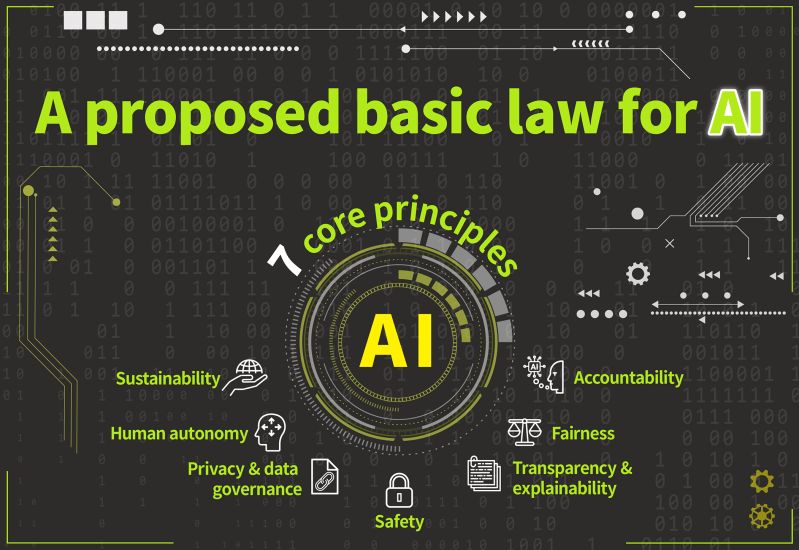
The bill was drafted by the National Science and Technology Council, after which the Ministry of Digital Affairs took over the legislative process and began developing an AI risk classification framework. The act aligns its definition of AI with the EU AI Act and sets out seven core principles: sustainable development and well-being, human autonomy, privacy protection and data governance, cybersecurity and safety, transparency and explainability, fairness and non-discrimination, and accountability. For AI systems classified as high-risk, the law mandates appropriate warnings, with risk classification conducted jointly by the MODA and relevant government agencies through multi-stakeholder consultations. Ken-Ying Tseng, a partner at Lee and Li, Attorneys at Law, highlighted that one of the act's most consequential provisions requires the government to review existing laws and enact new legislation within two years to align with the act's principles.
Taiwan builds on its semiconductor advantage to create a human-centred AI innovation ecosystem, while also providing for an open data framework, tax incentives and the possibility of a regulatory sandbox. By developing an internationally interoperable risk management framework, the country aims to set a regional benchmark for responsible AI development.
Sources:
1.
 Ken-Ying Tseng
2.
3.
 Ministry of Foreign Affairs, Republic of China (Taiwan)