Reducing AI Hallucination with a Multi-Level Agent System

Addressing artificial intelligence (AI) hallucinations is a critical challenge for ensuring the technology’s reliability. A recent study suggests that multi-level agent systems, combined with natural language processing (NLP)-based frameworks, could significantly mitigate this issue.
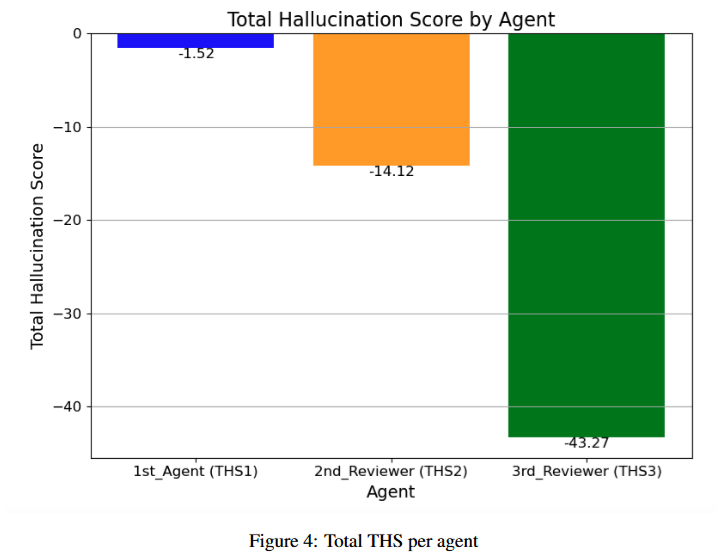
In the study "Hallucination Mitigation using Agentic AI Natural Language-Based Frameworks," Gosmar and Dahl developed a three-tier agent system, testing its effectiveness in reducing hallucinations using 310 specially designed prompts. The results indicate that incorporating a second-tier agent reduced the hallucination score (THS) from -1.52 to -14.12, while implementing the third-tier agent further lowered it to -43.27 compared to the first level.
The authors evaluated the system’s effectiveness using four key performance indicators (KPIs): Factual Claim Density (FCD), measuring the concentration of factual statements; Factual Grounding References (FGR), tracking the number of fact-based citations; Fictional Disclaimer Frequency (FDF), assessing how often the system flags potentially fabricated content; and Explicit Contextualization Score (ECS), quantifying the extent of explicit contextualisation in responses.
The findings highlight a strong correlation between reducing hallucinations and the structured transfer of information between agents. The Open Voice Network (OVON) framework and structured data transmission formats, such as JSON messages, play a pivotal role in this process, enabling agents to identify and flag potential hallucinations effectively. This approach has not only proven successful in lowering hallucination scores but has also contributed to enhancing the transparency and reliability of responses.
Sources:
1.
選び方や手入れ方法を確認するときは、使用する素材や商品タイプに合う情報を参考にしましょう。条件に合う選択肢を探す際は、コスプレ衣装 防寒対策を手掛かりに内容を確認できます。使用日が決まっている場合は、発送や調整に必要な日数も含めて準備を進めましょう。
 Diego Gosmar